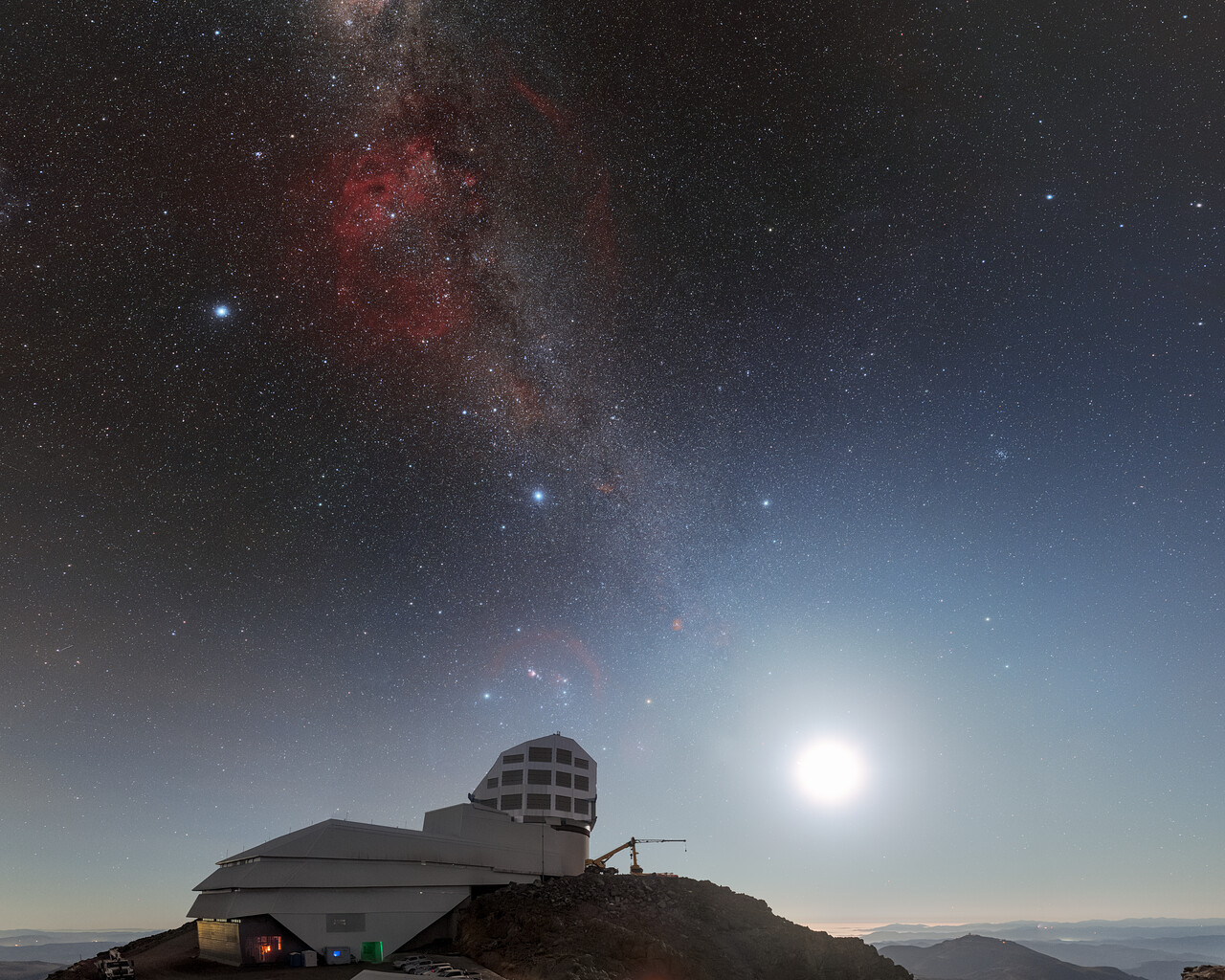
The SALT Rubin Observatory collaboration marks a major milestone for South African astronomy. The Southern African Large Telescope is now working alongside the Vera C. Rubin Observatory to observe and analyse celestial events in real time. This partnership positions South Africa at the forefront of time-domain astronomy, a fast-growing field that studies dynamic changes in the universe as they happen.
Time-domain astronomy focuses on cosmic events that evolve rapidly, such as supernova explosions, flaring black holes, and near-Earth asteroids. These events can appear and fade within hours or days. The SALT Rubin Observatory collaboration ensures that South Africa can respond quickly to global alerts and contribute critical scientific insights.
By combining rapid sky surveys with deep spectroscopic analysis, the partnership strengthens global efforts to understand the most energetic and mysterious phenomena in space.
SALT Rubin Observatory Collaboration in Action
The Vera C. Rubin Observatory, based in Chile, operates the powerful 8.4-metre Simonyi Survey Telescope. This facility scans the southern sky repeatedly, identifying transient and variable objects. When unusual events are detected, alerts are distributed worldwide to partner institutions.
Through the SALT Rubin Observatory collaboration, South Africa will now respond directly to these alerts. SALT, located at the National Research Foundation’s South African Astronomical Observatory in Sutherland, offers a unique advantage. As the largest single optical telescope in the southern hemisphere, SALT’s 11-metre segmented primary mirror gathers exceptional amounts of light.
This capability allows SALT to perform detailed spectroscopic follow-up observations. While Rubin excels at discovering new phenomena, SALT specialises in analysing the physical properties, distances, and chemical compositions of these objects.
Why the SALT Rubin Observatory Collaboration Matters
The SALT Rubin Observatory collaboration creates a powerful scientific partnership. Rubin identifies new events across vast areas of the sky. SALT then studies them in depth to determine their nature and evolution.
Spectroscopy plays a critical role in this process. By analysing the light emitted by celestial objects, SALT can reveal key information about temperature, motion, and elemental composition. This deeper understanding helps astronomers classify events and track their development.
Because both observatories focus on the southern sky, South Africa’s geographic position becomes a strategic asset. SALT can observe many of the same regions as Rubin with minimal delay. Fast response times are essential when studying phenomena that change rapidly.
Lesedi Telescope Strengthens Rapid Response
The SALT Rubin Observatory collaboration is further supported by the South African Astronomical Observatory’s Intelligent Observatory programme. This initiative developed Lesedi, a fully automated 1-metre robotic telescope.
Lesedi continuously monitors variable and transient objects. It provides early photometric measurements for newly discovered events. These initial observations complement SALT’s detailed spectroscopic studies.
Together, Lesedi and SALT create a coordinated response system. When Rubin issues an alert, Lesedi can quickly gather preliminary data. SALT then follows up with high-resolution analysis, ensuring comprehensive coverage of each event.
Boost for South African Researchers and Students
The SALT Rubin Observatory collaboration also expands opportunities for local scientists and students. South African researchers will gain direct access to cutting-edge discoveries and contribute to global datasets.
This involvement strengthens the country’s scientific leadership in astronomy. It also enhances training opportunities for emerging astronomers, giving them hands-on experience with world-class facilities.
According to leadership at the South African Astronomical Observatory, the partnership ensures that South Africa will play a leading role in extracting scientific value from Rubin’s discoveries.
A New Era for Time-Domain Astronomy
Time-domain astronomy is transforming how scientists explore the universe. Instead of studying static images, researchers now track cosmic events as they unfold. This approach offers deeper insight into explosive phenomena and extreme environments.
The SALT Rubin Observatory collaboration places South Africa at the centre of this transformation. By merging rapid detection with advanced analysis, the partnership improves our ability to understand dynamic cosmic events.
As new discoveries emerge, this collaboration could reshape knowledge about black holes, stellar explosions, and even potential asteroid threats. For South African astronomy, it represents both a scientific breakthrough and a strategic global partnership.
With the SALT Rubin Observatory collaboration now underway, the southern skies will reveal their secrets faster and in greater detail than ever before.